

BARI-UMA
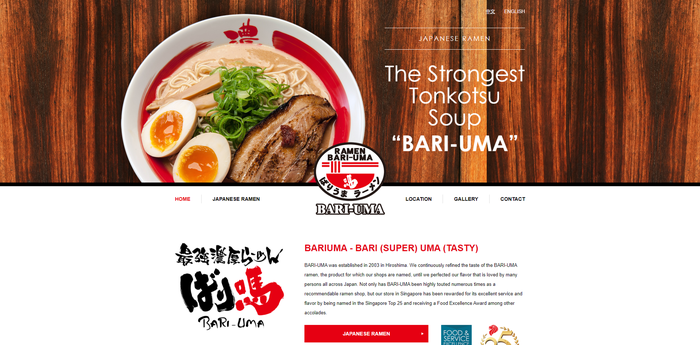
BARI-UMA is a Japan-born tonkotsu shoyu ramen brand founded in 2003, now successfully operating 25 locations internationally. This page covers its overseas expansion status, key operational features, and franchise contract types for international operators.
Overseas Franchise
Expansion Status
| Products and Services Offered | Ajitama-Uma (rich tonkotsu shoyu), Tori Ajitama-Uma (chicken paitan), gyoza, yakitori, chashu fried rice (donabe rice), and more |
|---|---|
| Countries of Overseas Expansion | Singapore, Malaysia, Indonesia, the Philippines, Australia, China, Hong Kong, the United Kingdom, and others (as of December 2025) |
| Number of Overseas Locations | 25 locations※ (as of December 2025) |
| Franchise Contract Type | Area license agreement / Master franchise |
10 Hours of Simmering.
Then Reduced Further.
That's the Soup.
"BARI-UMA" is a popular ramen brand with approximately 30 locations, primarily across western Japan, especially Hiroshima.
Its defining feature is an intensely rich tonkotsu shoyu soup—distinct from the more common milky-white tonkotsu style. While traditional tonkotsu ramen is already creamy, BARI-UMA takes that base further through extended reduction.
Carefully selected pork bones and chicken frames are simmered for more than 10 hours. The broth is then further reduced to evaporate excess moisture, dissolving marrow and collagen to their maximum potential.
The result is a luxuriously thick soup—almost potage-like in texture—that clings tightly to the noodles. Combined with rare tamari soy sauce, concentrated in umami, it produces a flavor with a presence that tends to stay with you.
The core menu item, "Ajitama-Uma," is supported by complementary offerings such as yakitori and donabe rice dishes, presenting a broader appeal of Japanese cuisine. As a franchise package, BARI-UMA has structured its system to deliver this experience globally without depending on highly skilled artisans.
Key Features of
the Overseas Franchise
Too Complex to Recreate Locally.
So It Ships from Japan.
BARI-UMA chose not to entrust its soup—the very lifeblood of ramen—to local preparation overseas. Instead, it ships the soup directly from Japan, even at higher cost, to preserve its defining flavor profile.
Crafting this richly concentrated tonkotsu shoyu broth requires delicate, continuous work by skilled artisans, including careful skimming and precise temperature control over long hours of simmering. Through proprietary technology, BARI-UMA successfully preserves this craftsmanship using advanced retort processing (shelf-stable packaging), ensuring both taste integrity and logistical efficiency.
This system provides two major advantages for overseas franchise operations:
- Consistent quality assurance: Stores across each of the brand's markets can reproduce the same richly concentrated soup as the flagship locations in Japan.
- Optimized flavor profile for global markets: The retort process reduces the strong "gamey" odor sometimes associated with tonkotsu broth, retaining only the deep umami preferred by many overseas customers—particularly in Southeast Asia.
Import the Soul.
Make the Noodles Locally.
To balance the investment in high-quality imported soup, BARI-UMA localizes noodle production.
Using proprietary recipes and noodle-making machines, each store can produce fresh, consistent noodles without relying on artisan skill levels. Rather than importing costly frozen noodles, the brand adopts an in-store noodle production model.
By utilizing local flour and water, ingredient costs are kept lower while preserving freshness and quality. This hybrid approach — importing soup to protect quality, producing noodles locally to manage cost — is what the overseas model is built around.
A "Showroom Strategy"
Centered in Singapore
For its initial overseas expansion, BARI-UMA intentionally opened a company-owned store in a prime, high-rent location in Singapore. This location functioned as a "showroom" for prospective investors from neighboring countries.
After experiencing the product quality and operational system firsthand, partners expanded the brand into Malaysia, Indonesia, China, and other markets. The Singapore model proved replicable. Subsequently, the brand joined the Yoshinoya Holdings Group, gaining access to substantial capital strength and global infrastructure. Supported by this network, BARI-UMA continues to accelerate its international expansion.
Reviews from Store Visitors
Store location reviewed: Edinburgh (United Kingdom)
I went for lunch at BARI-UMA with family. I tried the vegetable gyoza and the Yasai Kara-Uma (spicy soy vegetable ramen), while my husband had the Ajitama-Uma Extra. Everything was excellent, cooked just right! For dessert we tried the matcha ice cream and the red bean ice cream. Fantastic, and reasonably priced.
Store location reviewed: Kuala Lumpur (Malaysia)
Like the ramen! Like the thick broth! The restaurant is clean and service not bad. You chose give it a try!
Store location reviewed: Jakarta (Indonesia)
One of the best Ramen Restaurants in Jakarta! love it so much. you should try. for first timer, just order Bari Uma Ramen.
Store location reviewed: Jakarta (Indonesia)
I love the Ramen here! Found it accidentally. The texture of the noodles can be selected with choices of original, firm or soft. The selection of meat are Pork & Chicken. Service is good and prompt - value for money with quality taste. The chopstick are placed in this manner in respect to non-pork consumer, how appropriate! A must try if you are in the city. Small shopping mall but lots of food selection!
BARI-UMA
Company Information
| Brand Name | BARI-UMA |
|---|---|
| Company Name | With Link Co., Ltd. (Yoshinoya Holdings Group) |
| Head Office Location | 1-5-10-2 Tomominami, Asaminami-ku, Hiroshima-shi, Hiroshima, Japan |
| Date of Establishment | 1992 (Founded) |
【Quick Poll】What's driving your interest in a Japanese food franchise?
※ Click to see how others voted.

Make What Drives Margin.
One notable insight from interviews is that the retort-packaging technology, originally developed to reduce logistics costs, unexpectedly refined the flavor profile by removing the strong tonkotsu odor while preserving umami. What started as a logistics solution ended up making the soup more accessible to overseas palates — an outcome the team didn't fully anticipate.
I've watched a lot of ramen brands try to replicate their soup overseas. Most compromise somewhere. What Bari-Uma figured out is that you don't have to — if you're willing to build the logistics around it.