

Ootoya
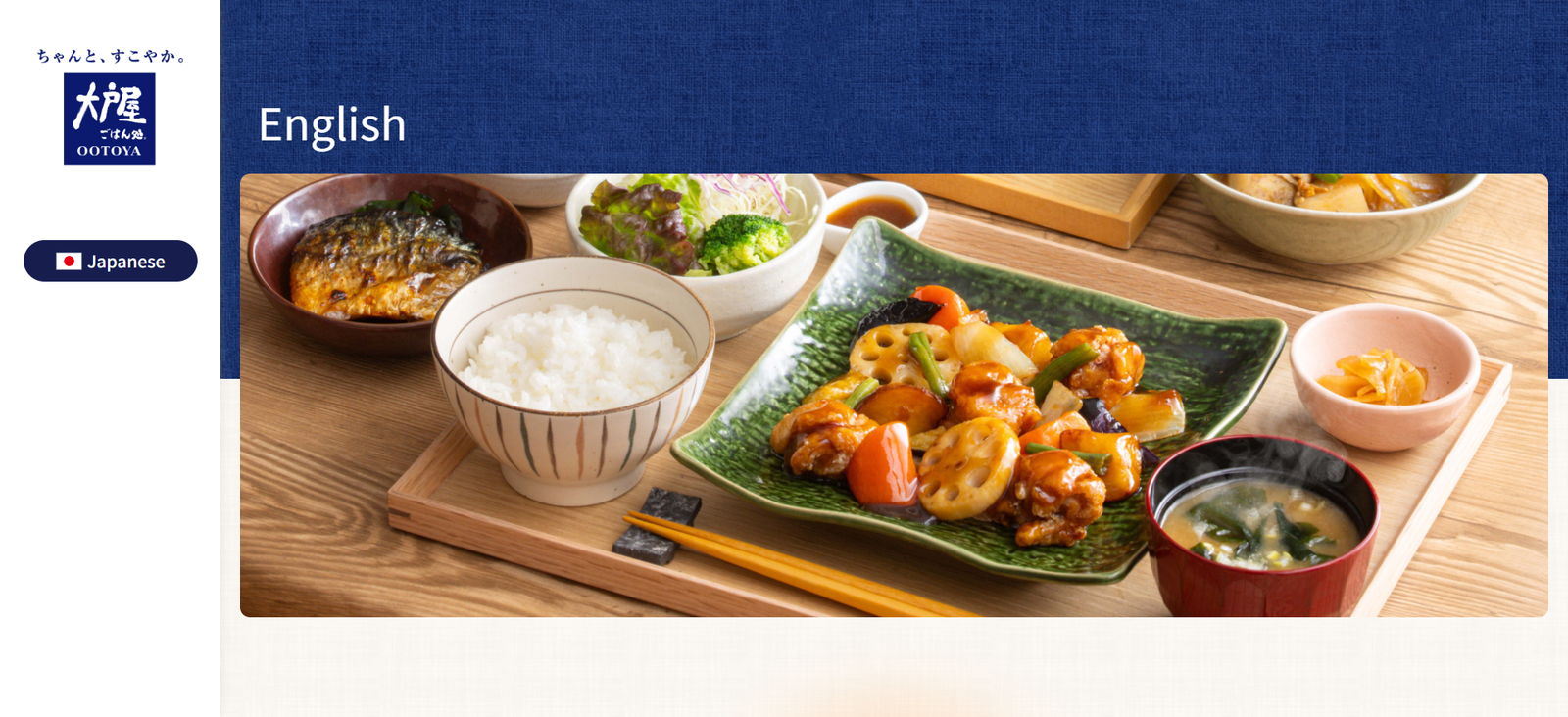
Ootoya is a Japan-born teishoku restaurant chain founded in 1958, now operating approximately 120 locations internationally across Thailand, Taiwan, Hong Kong, Indonesia, the USA, and Malaysia. This page covers its overseas expansion status, key operational features, and franchise contract types for international operators.
Overseas Franchise
Expansion Status
| Products and Services Offered | Teishoku (set meals with fish, meat, and vegetables), donburi (rice bowls), and Japanese side dishes |
|---|---|
| Countries of Overseas Expansion | Thailand, Taiwan, Hong Kong, Indonesia, United States, and Malaysia (as of January 2026) |
| Number of Overseas Locations | Approximately 120 locations (as of January 2026) |
| Franchise Contract Type | Master franchise / Area franchise |
The Chain That Cooks.
When Others Reheat.
While many Japanese restaurant brands expanding overseas premise their operations on using ingredients processed in central kitchens, Ootoya maintains a system of "in-store cooking" where vegetables are cut and dashi is prepared at each location.
In overseas markets, this approach occupies a distinct space from other Japanese food chains. Rather than competing on speed or price, the brand draws customers seeking something closer to home-cooked Japanese food — a segment that tends to be underserved in markets where sushi and ramen dominate the category.
Key Features of
the Overseas Franchise
The Handwork
Competitors Choose Not to Copy.
Operations mainly consisting of heating processed foods are easily imitated by local competing restaurants. Therefore, Ootoya intentionally retains manual processes such as charcoal-grilling fish and prepping vegetables, while systematizing an education structure that allows local staff to reproduce these tasks.
The cooking process conducted from scratch at each store generates the freshness and quality of the dishes. This hurdle of "reproducing handmade food" serves as a powerful barrier to entry, building a brand position that doesn't depend on being the cheapest option in the market.
That said, maintaining the in-store cooking standard — charcoal grilling, dashi preparation, fresh vegetable prep — across franchise locations where local staff training depth varies is an ongoing operational challenge. It's the same quality commitment that differentiates the brand, and the same one that's hardest to systematize at scale.
Japanese Seasoning.
Local Ingredients. Same Taste.
In overseas restaurant businesses, importing all ingredients pressures profits due to tariffs and transportation costs, while complete local procurement carries the risk of quality degradation.
Ootoya exports only the proprietary fermented seasonings that form the core of its flavor from Japan, maintaining the exact same taste as its domestic stores. Meanwhile, heavy items such as rice, meat, and fresh vegetables are procured locally and covered by the cooking techniques at the store. This hybrid procurement structure achieves both authentic quality and cost control by using local fresh ingredients.
No Single Ingredient
Can Break This Menu.
The teishoku style, which balances meat, fish, and vegetables, aligns with the growing interest in health-conscious eating in North America and Asia. This menu configuration, which uses diverse ingredients, functions as a defensive measure that flexibly absorbs the risk of cost fluctuations by guiding customers to alternative menus even when the price of a specific ingredient spikes.
Furthermore, unlike formats specializing in a single menu item, it creates a wide range of visit motivations, from office workers for weekday lunches to families on weekends. It gives the restaurant a reason to be in use across more of the day — weekday office lunches, weekend family dinners, without needing a separate concept for each.
Reviews from Store Visitors
"We met friends for brunch and enjoyed genuine Japanese cuisine and hospitality. The set meals are good, with salads and side dishes available. It's not Japanese cuisine for Americans, but the real thing."
"This is not a sushi restaurant, though they do have it on the menu. Instead they offer more traditional Japanese food that you rarely see in the US."
"Authentic Japanese food with a good atmosphere. The udon soup and the Donburi were worth trying. Centrally located."
"Agree this is more of a lunch place although they have sushi and sake, it's not that kind of kitchen. What they do is teishoku, which is a set meal served all together, common in Japan for lunch when people have limited time. And it's good and authentic, this being a branch of a Japanese chain. You can tell by the quality of the rice."
"Fast and efficient. A different kind of set meal but the combination worked well. Good, attentive service. Will go back."
Ootoya
Company Information
| Brand Name | Ootoya |
|---|---|
| Company Name | Ootoya Co., Ltd. |
| Head Office Location | Yokohama Landmark Tower, 2-2-1 Minatomirai, Nishi-ku, Yokohama, Kanagawa, Japan |
| Date of Establishment | May 1983 (Founded in 1958) |
【Quick Poll】What's driving your interest in a Japanese food franchise?
※ Click to see how others voted.

Reading through the reviews, a phrase that keeps coming up is something like "it's not Japanese cuisine for Americans, but the real thing." That's a specific thing for a customer to write, and it points at something the in-store cooking model is actually doing. When the dashi is made at the location, that tends to be the thing customers notice — even when they can't name exactly what's different.
The charcoal-grilled fish and freshly cut vegetables are genuinely harder to reproduce than they look. That gap between "hard to copy" and "impossible to copy" is probably the more honest way to describe what the extra work buys the brand. Worth understanding before evaluating how the model scales.